Cultist Simulator Review

A well-written horror-themed resource management game with permadeath
Games focusing on villainous characters are fairly rare. Games that take this seriously are even rarer. Most games where you play an evil mastermind are comedic and cartoonish, like Evil Genius or Overlord. Thankfully Cultist Simulator, while cartoonish, is far from comedic. It approaches the topic of being the mastermind behind a cult as you would see in horror and supernatural fiction with a healthy dose of maturity and more imagination than you can shake a shoggoth at.

Released in 2018 as Weather Factory’s first title, Cultist Simulator is the brainchild of Alexis Kennedy, co-founder and writer of Failbetter Games, the studio responsible for Fallen London and the notorious nautical horror game, Sunless Sea. Cultist Simulator is atmospheric, and well-written, but suffers from some gameplay issues. It was also fairly bug-ridden for the first few months after release, but those bugs have mostly been patched out. The game has several DLCs out, mostly adding new characters to play as.

Gameplay

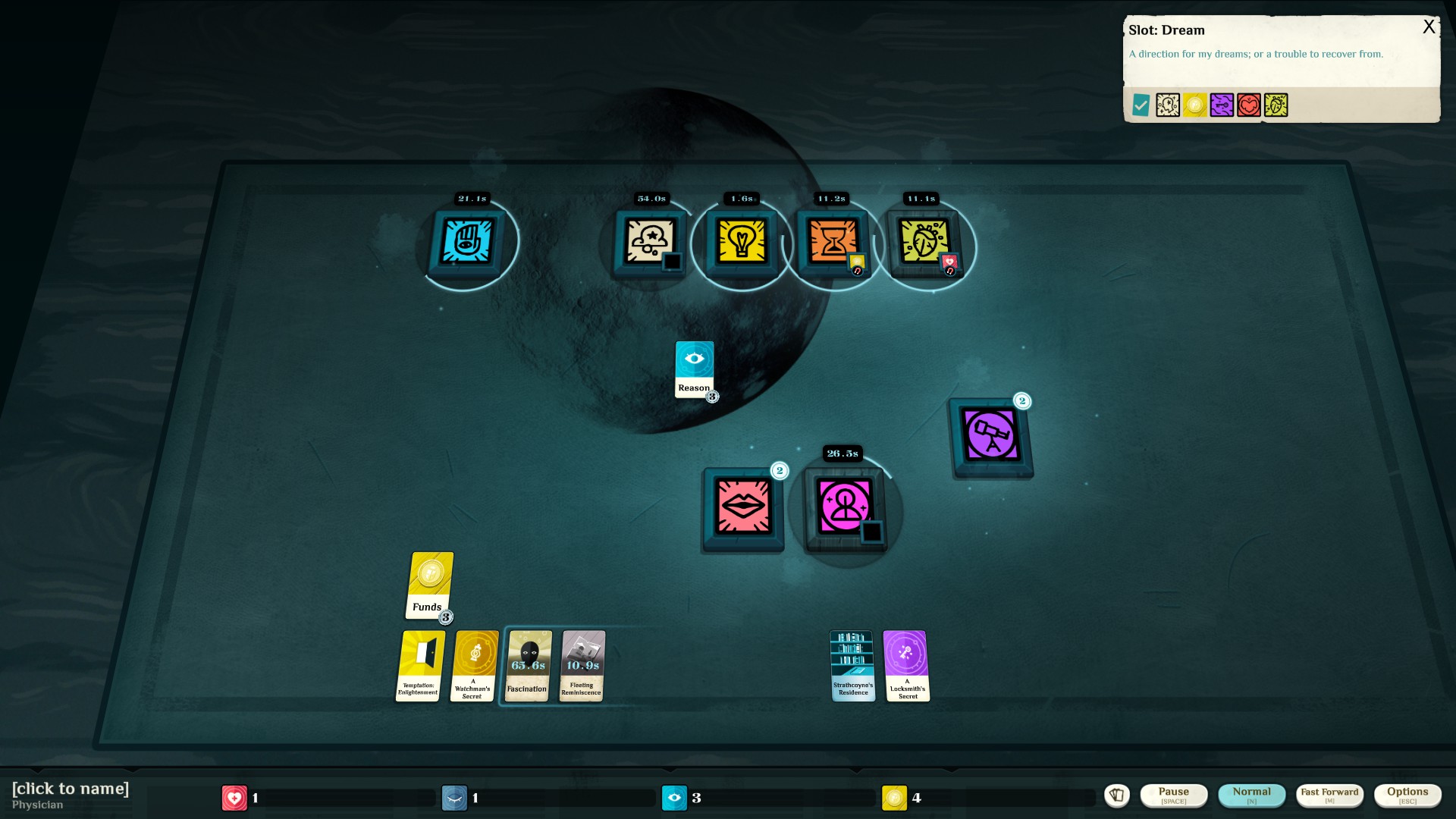
Cultist Simulator plays like a solo board game. You start with a couple of cards and events (or actions) with slots that can drag and drop them onto, which, in time, reward you with more and varied cards. You have cards denoting your main attributes: ‘health’, ‘reason’ and ‘passion’, cards for investigators and cultist minions, cards for the books and lore you uncover, and so on. These cards can be a bit abstract, so some imagination is required in their use. For example for the permanent ‘work’ event, using ‘health’ on this event will make you do manual labor, rewarding you with funds and sometimes vitality, which can be used to generate more health cards.
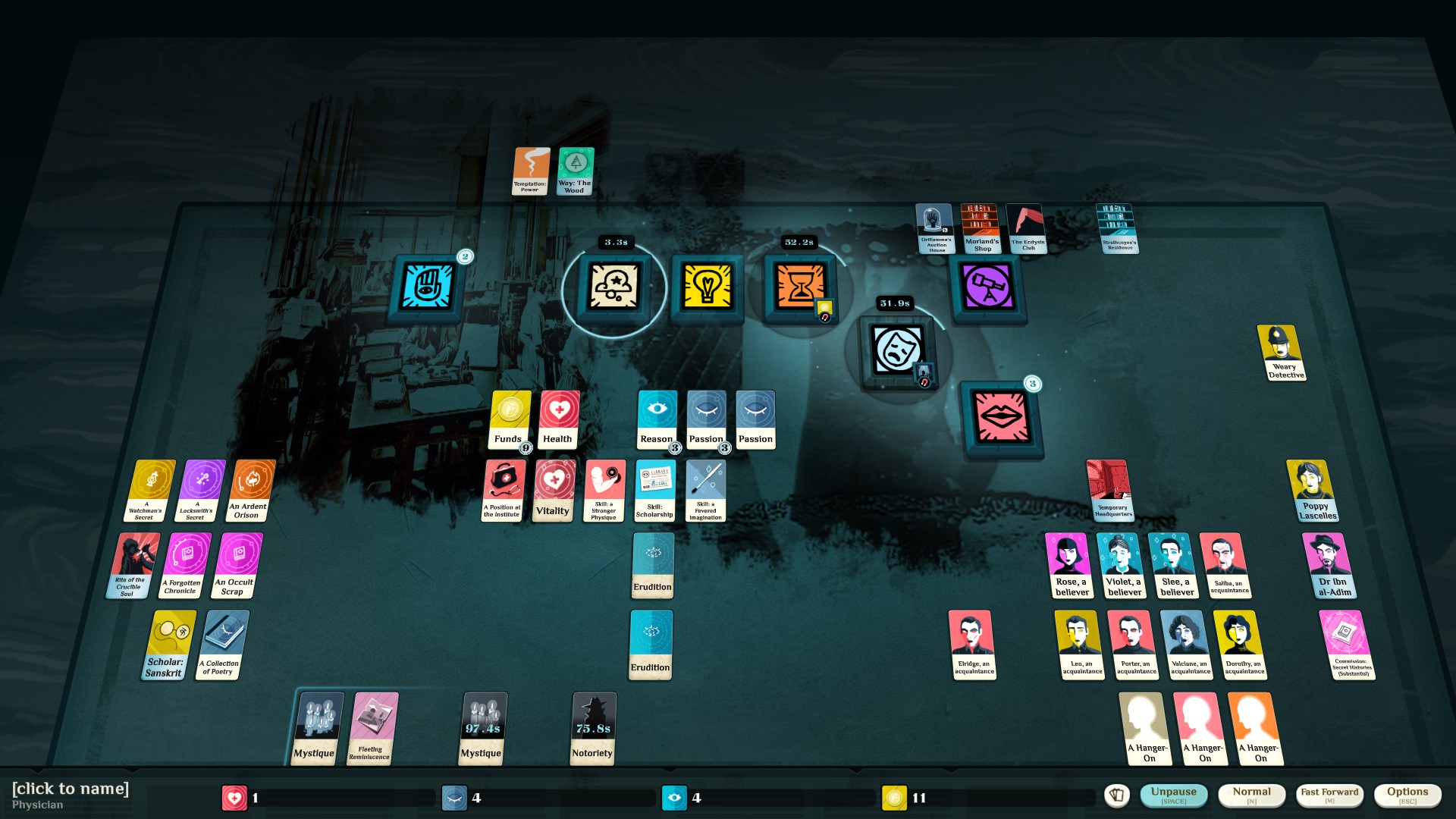
Unfortunately, working as a laborer can sometimes turn your health card into an injury card, preventing you from using that card until you treat it. If the timer on that injury card runs out before it’s treated, it will become a permanent ‘decrepitude’, effectively destroying a valuable health card. Instead you can get a nice, cushy office job that won’t give you injuries and takes ‘reason’ cards instead of health. On the downside, this sometimes requires more passion and mind cards than it says on the tin, as your abusive boss will force you to do overtime on the regular. Not working said office job for a couple of minutes will result in you losing it and having to waste a minute or so begging your boss to give your job back. If you’re not a fan of any of these options, you can use passion cards to make artworks, which usually requires a few more passion cards and a muse of some sort before you can actually make a living wage doing it.

Just like in real life, the tedious need to work is a compulsory part of the game. There’s a permanent ‘time passing’ event that regularly nicks your funds and will absorb health instead if you have no money. The sheer monotony of having to repeat this event every minute or so is probably a deliberate contrast to the many and varied cult activities you can undertake. It’s a clever way of reinforcing an underlying theme of escaping the drudgery of modern life into a (possibly delusional) world of supernatural intrigue, but it still makes the game something of a chore to play. The same goes for staving off other potential causes of death, such as depression and madness. Every now and then your activities will give you dread and fascination cards, which can give you a gameover if they build up too much. Early on, this felt like a big deal, and I struggled to find ways to counteract them. After working out how to reliably generate the cards that counteract these events, they became another part of the dull routine.

Advancing the goals of your cult generally requires sending your minions on expeditions to various locations of interest and overcoming the obstacles at these locations. Every minion, hireling and summoned spirit has a different spread of stats in several different kinds of ‘aspects’. Obstacles are overcome by sending the right minion to do the job. For example, to defeat the guardians of a warehouse that supposedly harbors some suspicious artifacts, you can either fight them by sending followers with the ‘edge’ aspect, or deceive them by sending followers with the ‘moth’ aspect. Your actual cultists generally start out with terrible stats, so it’s a good idea to pay for temporary hirelings to help out with your expeditions. For finishing an expedition you can get a mix of books, items and ritual ingredients. Books are generally the most important item as you can use them to generate scraps of lore, which are used to find your way through the dream world of ‘The Mansus’, among other things.
Every now and then, the tedium gives way to some interesting situations. For example, dealing with investigators and rivals is always fun, mostly due to the many options at your disposal. I ignored the weary detective building a case against me until he managed to get his hands on some strong evidence against me, at which point I realised that none of my minions were competent enough to sabotage the evidence. The detective ended up arresting and imprisoning one of my minions, and it was at that point that I decided I had to get rid of him. I remembered hearing that it’s possible to drive investigators insane by sharing higher level lore with them, so I tried that. Unfortunately, I must have used the wrong lore, as it backfired and the detective doubled down on his resolve and gained some bonus attributes, making him stronger than ever. I tried again and this time it sort of succeeded. I say ‘sort of’ because he decided to quit his job as a detective and became a rival cultist, which ended up working in my favour. He provided a welcome distraction for other detectives that turned up looking for me, and eventually ended up murdering one of them. Good job, Doug.

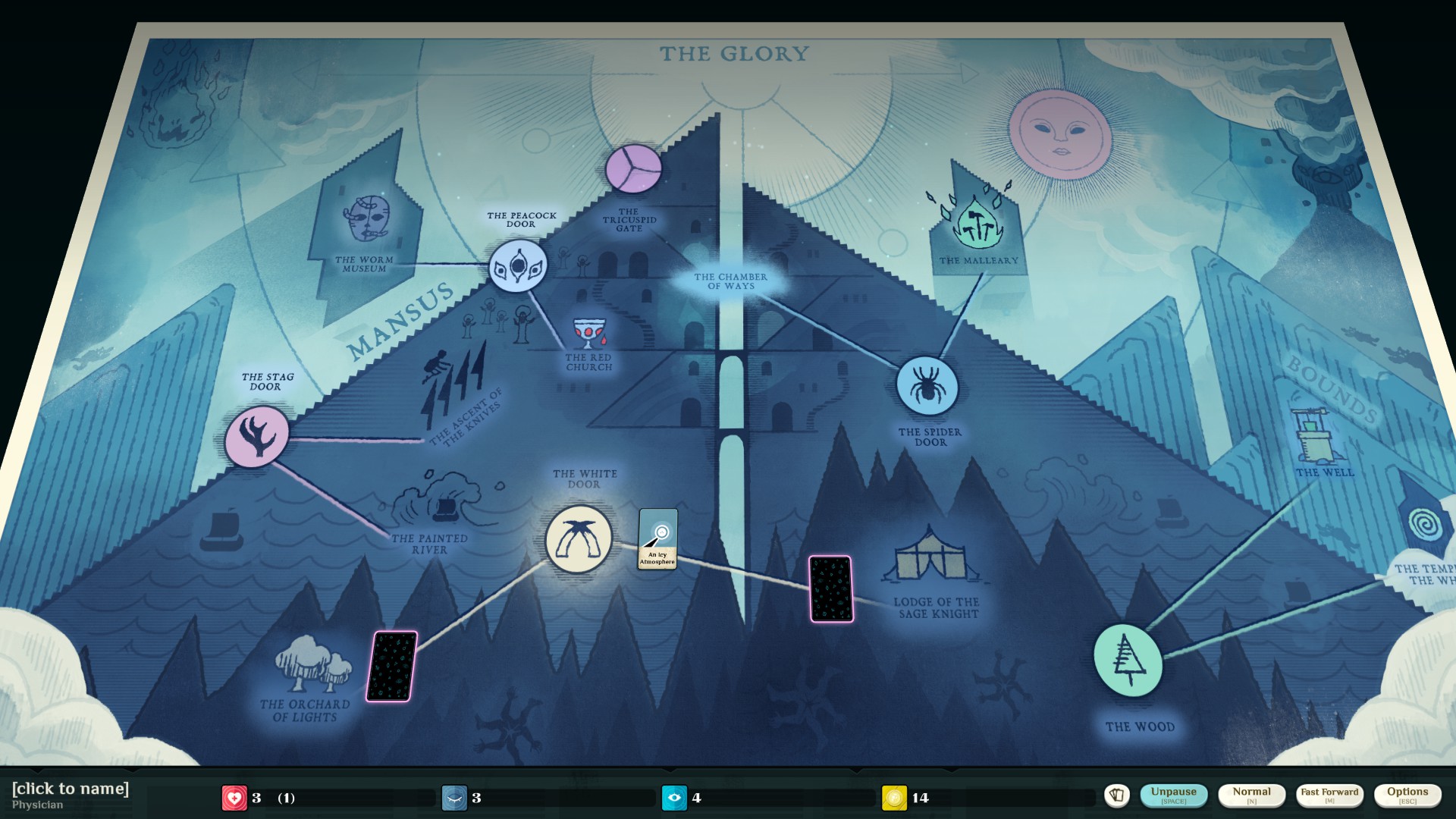
Aesthetically it looks like someone dropped a few too many paint cans on a Tim Burton set. The presentation is surprisingly colourful for such a morbidly themed game. The Mansus in particular looks fantastic as an abstract representation of a dream world. Every now and then, ghostly illustrations will slowly fade in and out of the board as certain events occur, sometimes to alert you to potentially threatening events that you’ll need to deal with. Overall the art style is fairly simple, but it’s consistent with the atmosphere and colours are often used to indicate what particular attributes some cards have, making it easier to find certain cards at a glance. The table that you have all the cards on could use a little more detail though. You spend all your time in the game staring at it, so it would nice to have some candles or books at the corners of the . Maybe a window to the outside world, where the view you have could be affected by the events currently occurring.

Story

That anecdote was also an example of how the narrative evolves based on your actions. You have a lot of actions available to resolve certain situations, and each one has consequences. You could summon a monster to kill a rival or investigator, but it might break free and eat one of your minions. You could start an affair with one of your cultists and then accidentally ignore them until they become disaffected and leave to start their own rival cult. The possibilities, while not endless, are at least plenty.

Your story begins simply enough: you work as a porter at a hospital and bond with an elderly patient. This patient soon passes away, leaving his belongings to you. Aside from a rather generous amount of funds, this includes some suspicious documents. Studying the documents piques your interest into the unknown by providing you with a scrap of lore from the ‘lantern’ aspect, which can be used to find your way to Dream World of the ‘Mansus’. From there you can find contacts which whom to found your cult and choose the founding principles (will you strive for power, enlightenment or something else?). From there, the game does a decent job at making you feel like a cult leader delving into the unknown as you translate antique books of obscure languages, trade this knowledge with interested patrons, and slowly piece the lore together into a deeper understanding of the complicated supernatural world that lurks beneath the surface of the game.

The specifics of the story – the how and what of your actions – are told eloquently through the prosaic shreds of information you find on the cards and events. The flavour text itself is both evocative and foreboding, while never quite revealing enough to dispel the mystique of the setting. This is an impressive achievement when considering the sheer amount of text in the game. The style of the writing is certainly reminiscent of H.P. Lovecraft, but lighter and not quite as verbose. Kennedy’s mastery of this particular style of writing is on full display in Cultist Simulator, as he deftly weaves a world full of strange spiritual intrigue and ambiguity while omitting just the right amount of detail so as to keep the setting from becoming mundane.

The setting itself is also inspired by Lovecraft, but moreso his Dunsany-inspired Dream Cycle series than the usual more depressing Cthulu Mythos suspects. There’s a surreal fantasy impression to most of the lore you uncover, and the dream world of the Mansus could have been ripped straight out of the one of the Dream Cycle stories and I wouldn’t have been able to tell. The ‘hours’ are basically the deities of the Cultist Simulator setting, and seem like the pantheon of gods from a high fantasy setting than the alien abberations of Lovecraft’s works. The more I learned about the Mansus and the Hours, the more I found it weirdly reminiscent of Garth Nix’s YA fantasy series, The Keys to the Kingdom. Kudos to anyone who actually read that.

Conclusion

My most recent run ended prematurely when I accidentally left the game running while I was away from the PC. Perhaps more disappointing than this is the fact that I don’t really feel inclined to try again. Usually roguelike games encourage replayability and experimentation by giving you the option to build different types of characters and include the allure of the randomly generated environments and items. In Cultist Simulator, the ability to use a variety of different cards to resolve events is what makes the game differ from playthrough to playthrough. However, none of these options feel like they change or mitigate the grindiness at the heart of the game. There’s not really any challenge to the game, aside from the initial learning curve of having to figure out how to not die to perfectly mundane events. The thought of having to painstakingly climb back up to where I was before was enough to keep me from wanting to replay it again and in turn makes it difficult to recommend.

The easiest way to solve this would be for the developers to add a way to automate certain actions, like constantly repeating your office job and having it automatically take the cards it needs if you work overtime. Unfortunately though, this has been a common suggestion from the community, and it doesn’t seem like the developers plan to implement a feature like this any time soon. To me it seems like the tedium is intended, but I honestly don’t think it really adds enough to the narrative for it to warrant making the game frustrating to play, especially since it has obligatory permadeath. This makes it difficult to recommend to anyone but hardcore fans of Lovecraft and gothic horror.

Overall Cultist Simulator is an interesting experimental title with exceptional writing and a fitting art direction hampered by a core gameplay loop that is mildly interesting at best and tedious at worst. If you’re willing to accept some compromised gameplay for an interesting narrative experience, go for it. If not, maybe pick it up when it’s in a humble bundle or below ten bucks on steam.

Mordhau Review

A visceral and chaotic multiplayer medieval combat sim

In late 2012, Torn Banner Studios released Chivalry, a brutal, yet oddly comical multiplayer medieval warfare title based on their popular source engine mod, Age of Chivalry. It was a huge success for the small studio, selling over two million copies within two years. Over time, the once large playerbase petered out until only the more dedicated players remained. Any new player trying to get a foothold in the game would soon have been put off by the veteran players who had reached the top of the ridiculous skill ceiling. High skill gameplay in Chivalry eventually became a contest of seeing who could spin around in the most confusing way possible, so as to make the timing of their attacks unreadable. These combat techniques eventually culminated in a maneuver that Chivalry veterans liked to call the ‘rainbow’, wherein you start an overhead swing while spinning around to face upwards and away from your opponent. This means that your weapon starts it’s swing arc while already making contact with your opponent, thus resulting in a near-instant, nigh unblockable attack. It also looks pretty ridiculous in action. Understandably, a group of former competitive players decided to make their own medieval combat sim to remedy the problems they found in Chivalry, and thus Mordhau was born. Or rather, Kickstarted.

Gameplay

Mordhau has three main modes: frontline, horde and battle royale. Frontline is what I’ll be referring to for the most part, as it’s the most popular mode and likely what you’ll be spending most of your time in. In frontline players fight for control over a few key locations on the map, sometimes needing to complete specific objectives before capturing said locations. Each location you capture will cause your opponents score to tick down until it hits zero, in which case your team wins. Horde pits a small team (usually six players) against 21 waves of highly aggressive AI controlled enemies. Each enemy defeated earns points that can be spent of various weapons and armor spread throughout the level. Finally, battle royale is a free-for-all in which players are dropped into random locations on a large map and must use their scavenged weapons and armor to survive until they’re the last man standing.

In addition to these modes there’s also team deathmatch, free-for-all and skirmish. With the exception of skirmish they’re fairly self-explanatory. Skirmish is essentially a round-based team deathmatch, with players respawning at the end of each round.

Rather than having weapons be restricted from class to class like Chivalry, Mordhau gives you 16 points to allocate to weapons, armour and perks as you see fit. This generally means that if you want a heavy weapon like a maul or a zweihander, you’ll have to make some concessions with your armour. The most popular way to skimp out on armour tends to be to wear no leg armour, seeing as players rarely deliberately aim for your legs (protip: aim for the legs). Perks are pretty hit or miss, most are highly situational. A couple of perks that I found to be pretty useful are ‘fireproof’ which protects against damage from fire bombs, and ‘friendly’, which reduces damage dealt and received from teammates; an ever-present scourge in Mordhau.

On the subject of friendly fire, it’s incredibly common in Frontline. Within a couple of hours of starting up Mordhau for the first time, I guarantee you’ll have lost count of how many times teammates will have accidentally lopped your head off in their haste to attack an enemy next to you. Despite this, I recommend against playing on servers with friendly damage disabled. Why? Because the fact that you can’t just bunch up with your allies and roll across the map like a giant spiky deathball makes the game more dynamic and makes weapons other than the zweihander and executioner sword useful. It also makes thrusting attacks important, despite them being slightly harder to aim than simply slashing. This means that players eventually organically form up into nice, ranked battle lines, poking and prodding for weaknesses in the opposing line, rather than simply rushing in doing the largest possible horizontal swings with a poleaxe.

Sound design in Mordhau is excellent. There are satisfyingly juicy sound cues for most important actions, such as landing a hit, parrying, chambering and so on. Being in the middle of a large battle sounds pretty much how you would expect it to sound; battlecries, shouting, screaming and clanging drowning out everything else. Unfortunately the hoofbeats of an approaching horsemen are hard to hear before it’s too late. There’s also supposedly a sound cue for hearing a catapult fire, but I’ve never managed to hear it.

Combat

Melee combat is the bread, butter and most complex aspect of Mordhau. Similarly to Chivalry, you can choose from an extensive arsenal of medieval weapons, each with differing damage output, range and speed. Left click will swing your weapon from whatever direction you last moved your mouse, scrolling up on the mouse wheel results in a thrusting attack and scrolling down performs a vertical downward slash. Different weapons excel at different things. A long spear, for instance, has an excellent range and deals a lot of damage on a thrusting attack, but if you try to swing it horizontally you’re probably going to hit every wall, obstacle and friendly player in a five mile radius before dealing much less damage to your foe than if you were thrusting it anyway.

The trickiest part of Mordhau is figuring out how to hit people with the aforementioned weapon. To parry you click the right mouse button when your foes attack is about to connect. Parrying is quick, easy to pull off and has a lot of margin for error. This means that simply running towards an opponent and mashing the attack button rarely works.

To get around an opponents guard, you’ll usually need to trick them into parrying early. Pressing ‘Q’ during the wind up time of your attack will result in your character canceling the attack animation. You can also morph one type of attack into another by pressing both attack buttons in quick succession, this changes up the timing of your attack and keeps an opponent guessing. Of course, none of this matters if your opponent has a shield. Shields can be used to block attacks indefinitely, effectively making timing a non-issue. Luckily, you can kick regardless of what weapon you’re holding. Kicking is nature’s shield remedy; it can deal a small amount of damage through a foe’s guard and will knock the shield out of the way. Queuing up an extra attack after kicking will usually be fast enough to get a decent hit in before your opponent raises their shield again. Kicking isn’t a very precise science though. While fairly fast, it has a very short range. Missing a kick will leave you wide open to being attacked, and heaven forbid you do so with more than one enemy nearby. Optionally, if an opponent is particularly aggressive, you can cancel out their attack with one of your own by launching the same kind of attack just as theirs is about to hit. This is fairly easy to accomplish when your opponent is using thrusting attacks, and a much harder when they’re slashing, as you have to match the direction they’re attacking from to successfully chamber.

The combat system is definitely the selling point of the game, and for the most part, it feels fantastic. You have a lot of control over your actions, and whenever your die it’s usually easy to see where you went wrong and what you could have done differently. In can be frustrating to be ganged up on by multiple opponents (a common occurrence in frontline), but with some clever tactics and footwork it’s definitely possible to get the upper hand, leaving you with a genuine feeling of accomplishment when you do eventually manage to triumph over a ganksquad on your lonesome. Where the game really shines though, is one-on-one encounters. A one-on-one duel with a decent opponent is a tense game of wit as you both try bluff the other into losing their composure and blocking at the wrong time. Eventually I found myself using all of the options available to me in these fights; feinting, morphing, chambering, even kicking—which I once reserved for use only against shield-wielding foes—eventually found its way into my repertoire. This variety of options sets Mordhau apart from its spiritual predecessor Chivalry, which only had feinting, and make for a much needed enhancement on the much neglected medieval combat sim genre.

Maps

The maps look pretty good. I’ve been somewhat spoiled by Chivalry’s exaggerated, almost fantasy-like visual flair, so Mordhau’s bland and realistic maps are slightly underwhelming by comparison. Camp is the worst in this regard, but it’s hard to fault it for this since it seems intended to look like a grimy, muddy mess.

With that out of the way, there’s one particular aspect that lets Mordhau down when compared to Chivalry: the maps. Chivalry’s objective based maps were visually appealing and highly focused, with interesting set pieces and chokepoints. The maps never failed to guide the attacking players to the objective and the defending players to the frontlines. For some bizarre reason the Mordhau developers thought it would be a good idea to roll objective based gameplay and Battlefield-style point domination into the one gamemode. The result is rather lackluster. You can complete objectives to win the round, but there’s no real need to. The most reliable way to win is always to just hold one more point than your opponent. In some cases the objectives will distract your team from actually holding that extra point. One map that exemplifies this is Taiga. To win Taiga, all your team needs to do is hold the fortress in the middle of the map. Once the blue team holds the point inside the fortress they can spawn on the other side of the fortress. Problem is; right next to that spawn point is a gate leading to the next objective/point. This means that the majority of players tend to run through that gate and start trying to fight their way toward the next objective, without so much as a thought as to whether the point that allows them to spawn there needs to be defended. This is compounded by the fact that the moment your point is being contested by enemy players, you can no longer respawn near it, meaning you have to spawn over the other side of the map and slowly make your way over to defend a fortress that has probably already been taken.

The other issue I had with the maps is that if often felt like they weren’t quite being used to their fullest potential. Some of the maps are huge, with lots of small details, hidden passages and nooks/crannies, yet the nature of the Frontline mode is that the majority of the time is going to be spent fighting in the same couple of locations, and the rest of the map goes to waste. Best example of this is Grad. The map seems to be based on a siege, with blue starting out in a huge, lovingly rendered castle and red starting in a small camp outside. After the match starts, both sides eventually cap their first points and meet at the point in the middle, in a small village outside the castle. Henceforth 90% of your time is going to be spent fighting around the stables in said village. On the rare occasion that the red team pushes all the way to the castle, they can potentially end the match by killing the NPC king, who wanders around the castle with an enormous maul waiting for red players to start invading. This part is really what the map felt like it was designed for; there are a lot of ways to defend the keep and a lot of ways to invade it, making for a lot of potential fights in interesting locations with a lot of available chokepoints. There’s even a surprisingly detailed network of tunnels beneath the castle that can be used to infiltrate the castle from unexpected areas. Nobody uses them of course, because by that point the red team will have had to capture every other point meaning that blue will likely lose to point attrition within a couple of minutes regardless of whether or not the king dies, so there’s no incentive to do anything other then skirmish around the last point. The only map that doesn’t really suffer from this problem is Mountain Peak, which, by no coincidence, is also the smallest map. This issue could be fixed by adding a purely objective based mode in the vein of Chivalry, with one attacking team trying to accomplish the objectives and the defending side trying to stop them.

Conclusion

As of early June, they released a free content update in the form of a new map, a new weapon and a variety of balance changes. If this is a sign of things to come, I have high hopes for the future of the game. The developers will need to have small content updates like this on a fairly regular basis to keep the momentum going, especially in the face of an upcoming Chivalry 2 and (eventually) Mount and Blade 2. Overall, Mordhau has managed to fill the Chivalry void and then some, providing a much needed fix of medieval combat sim with one of the most engaging melee combat systems I’ve ever played.

How Metro 2033 does worldbuilding better than Exodus

Metro 2033 is easily one of my favourite FPS games of all time. The gritty, grimy setting, smooth gunplay and beautifully rendered environments had me hooked right from the first chapter. Of course, Metro Last Light was pretty good as well, but didn’t quite live up to the original for me. Naturally when Metro Exodus was announced I was stoked. To me, the issue of Metro Exodus being an Epic store exclusive, and the ensuing cold war between Steam and Epic was only a sideshow – I just couldn’t bring myself to care. Now, having played Metro Exodus, I couldn’t help but feel let down, despite generally enjoying it. It was missing something that was vital to the original game. Despite the obviously superior graphical fidelity and varied, open environments, the world it attempted to construct around me just didn’t feel authentic.

The reason for this lies in the differing way in which they present their environments: specifically, in characters and design choices of the original game.

The story of Metro 2033 plays out in a fairly traditional way, with plenty plot devices and characters that we’re fairly used to seeing, albeit often not in a post-apocalyptic setting. There’s a mysterious existential threat looming over the Metro (the Dark Ones), and accordingly, the protagonist’s much looked up to mentor tasks him with warning the rest of the world about said threat. Along the way, the protagonist meets a variety of more worldly characters that fit neatly into common storytelling tropes, a roguish character familiar with the underbelly of banditry rampant in the metro, a mystic shaman-esque character who guides the protagonist through some of the many haunted tunnels in the metro.

Metro Exodus replaces a lot of these classic adventure tropes with a smorgasbord of post-apocalyptic clichés. Slavers, zombies, bandits, cultists who sacrifice their own people to a giant monster, cannibals, bandits, and more bandits. The significant difference here is that Metro 2033 uses tropes to introduce the unique setting, whereas for Metro Exodus the tropes ARE the setting. If you take away the post-apocalyptic staples, there’s very little of substance left.

Also, what the hell – how are there even so many bandits in the wasteland when there are virtually no normal people around? How do they make a living? How do they even reproduce when there are no women in a five-mile radius? It’s a mystery.

The threat of the Dark Ones is the underpinning narrative of Metro 2033. They are the reason the player sets out into the world in the first place, and the game constantly reminds you of this, as you see the Dark Ones observing you during encounters with some of the more ghostly phenomena in the tunnels. The game communicates their intentions through the story and details in the setting. At the beginning of the game, the player is told that they are hostile and that the rest of the metro must be warned about them, and the hospital in the starting village is full of soldiers left debilitated by their traumatic encounters with the Dark Ones, making it pretty clear that they are indeed a threat to the Metro. However, in the player’s encounters with the Dark Ones, they are shown to be more curious than anything, and sometimes even provide assistance when the player finds themselves in a tight spot. This dilemma is a major source of tension throughout the game, as the player begins to see signs that, despite their sinister appearance and the hostile nature of the rest of the setting, maybe the Dark Ones are not really hostile after all.

Metro Exodus does away with the supernatural undertones and overarching enemy of Metro 2033, instead opting for the vague goal of finding what remains (if anything) of the Russian government. To this end, the player spends most of their time meandering in the wasteland wilderness to get whatever he needs to be able to meander to the next post-apocalyptic set piece so they can be given a new set of objects to clear before they can continue their journey to nowhere. There’s no real continuity between the areas… unless you really care about the characters. Ah yes, the characters.

After long and lonely segments of crawling through mutant infested tunnels of Metro 2033, punctuated by the occasional settlement full of downcast denizens going about their daily life unaware of the threat of the Dark Ones, I really came to appreciate the occasional companion. The tropes that the characters adhere to made their perspectives on the metro make sense and helped make the setting more coherent. Now let’s compare this to Metro Exodus; instead of slowly introducing characters to build up the setting, Exodus throws more characters than the player can possibly keep track of from the start. Most of these characters have a couple of lines in each area to give them a bit of personality, but after clearing several chapters I still couldn’t quite remember most of their names, let alone their personalities.

For the most part, the characters in Metro Exodus are there to provide the player with something to do. Some of the characters give out optional missions, some of them accompany the player on missions, some of them die to make the player feel guilty for not doing all the optional missions in an area. It’s a fairly common (but clumsy) approach to open-world gameplay. The end result is that the characters aren’t memorable and don’t really have anything interesting to tell the player about the world.

The use of ammunition as currency that was an almost iconic feature of Metro 2033 and Last Light has been done away with in Exodus and replaced with a staple of the open world genre – a crafting system. In some ways this is a sensible move, as you’re very unlikely to come across merchants in the open world wastelands, but it was still a distinctive part of the setting and removing it makes the setting feel just that little bit less authentic in comparison to Metro 2033.

Gas mask use was a must when you’re on the toxic surface in 2033, and running out of the fairly rare replacement filters meant certain death if you can’t find a way back to the safety of the tunnels, this too has been mostly made obsolete in Metro Exodus. The surface is for the most part clear of toxic gases now, with gas masks required for only small segments of gameplay. Filters are also nowhere near as rare, as with the crafting system you can build a dozen of them out of materials you can get from a stripping a few guns and finding some cans of baked beans. I don’t dislike the crafting system as it is, but the features that it replaces were an important part of the series and the fact that it makes the scarcity of resources seem like a complete non-issue really made the world less believable for me.

Metro Exodus is a decent game in its own right, and in many ways superior to the original games. For all the issues I had with the story and world-building, it was still fun to play. The gunplay was tight and responsive, the visuals are some of the best I’ve seen in a modern game, and the sound design is excellent. This made it all the more disappointing for me that they opted for a more generic open world setting, forgoing the unique atmosphere and design choices of the original Metro 2033.